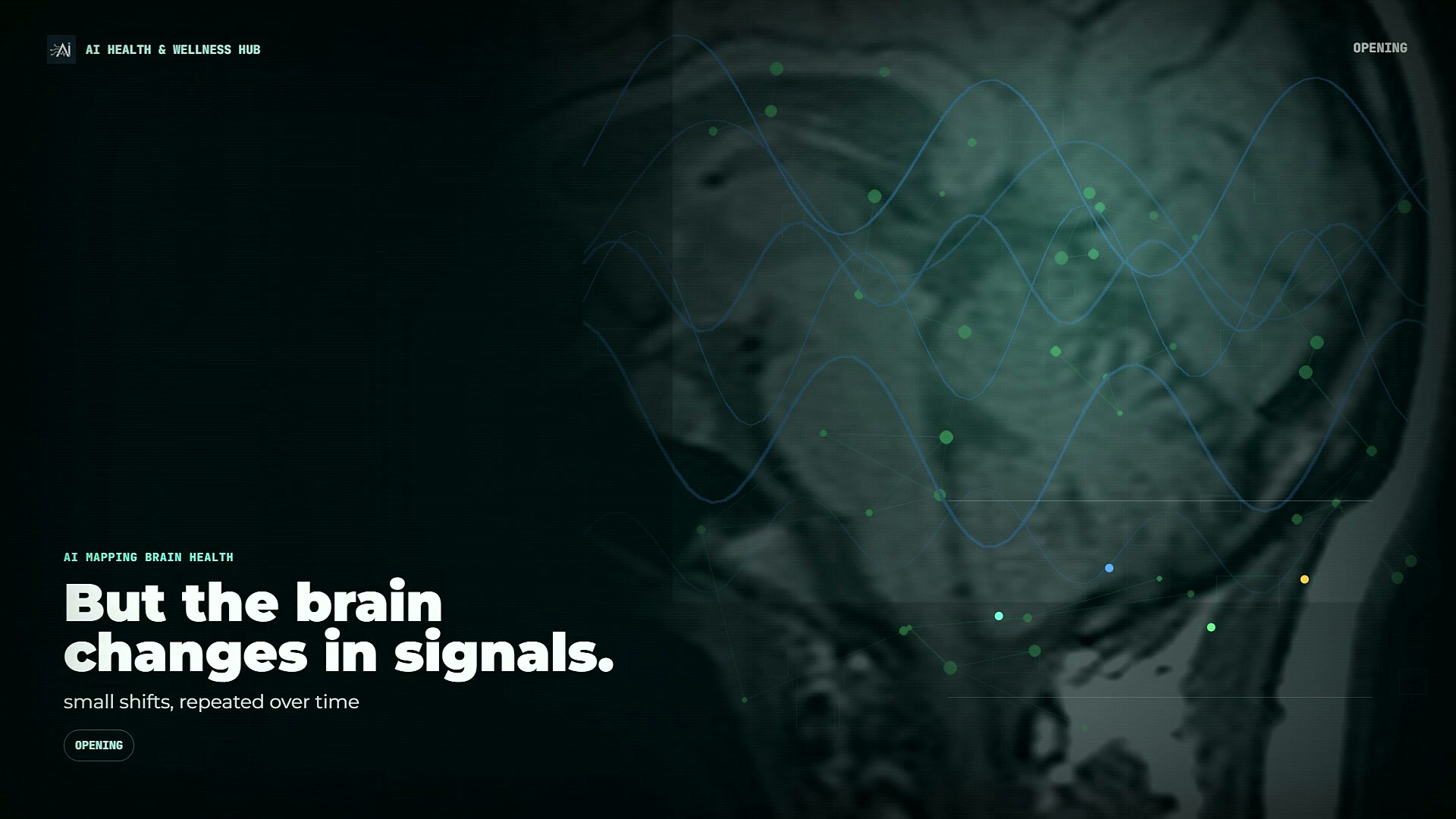
Brain health used to be treated like a snapshot. A person felt different, booked a visit, took a test, maybe had imaging or lab work, and waited for a single answer. But the brain does not change in snapshots. It changes through signals that repeat over time.
Sleep shifts. Speech rhythm changes. Reaction time slows. Walking patterns become less steady. Stress, blood pressure, glucose, hearing, vision, medication, social contact, exercise, and nutrition all leave traces. The challenge is that those traces often live in separate places.
Why AI Brain-Health Mapping Matters
The most useful question may not be, "Is this normal?" It may be, "Has this person changed compared with their own baseline?" That is where AI becomes interesting. Not because an app can diagnose the brain by itself, but because algorithms can help connect weak signals over time and make subtle changes easier to discuss.
The stakes are real. The World Health Organization reports that more than 57 million people worldwide live with dementia, and Alzheimer's Disease International projects that number could rise to 78 million by 2030 and 139 million by 2050. At the same time, the 2024 Lancet Commission reported that a large share of dementia risk may be linked to modifiable factors across life.
The Signal Maps AI Can Help Connect
Imaging: MRI, CT, and functional imaging can reveal structure, blood flow, and activity patterns. AI systems may help segment anatomy, compare scans, estimate brain-age patterns, or detect subtle differences that are hard to measure consistently by eye.
Sleep and recovery: Wearables and home devices already collect sleep timing, movement, heart rate, breathing, and sometimes oxygen patterns. On their own, these numbers can become noise. AI may help turn them into context by comparing patterns against a person's own history.
Speech: Speech carries pace, pauses, word finding, sentence complexity, emotional tone, and attention rhythm. Researchers are studying whether voice and language patterns can support earlier conversations about cognitive change, depression, neurological conditions, or medication effects.
Movement: Gait, balance, tremor, reaction time, typing rhythm, grip strength, and daily activity can reflect changes in health. A phone, watch, ring, or camera cannot explain those changes alone, but AI may help flag when patterns drift from someone's usual range.
Life context: Brain health is shaped by blood pressure, diabetes, cholesterol, hearing, vision, air pollution, loneliness, depression, education, head injury, smoking, alcohol, exercise, nutrition, and sleep. A useful AI tool should help organize that context, not replace the clinician.
Prediction Is Not Diagnosis
AI brain-health tools need guardrails. A model trained on one population may not perform well for another. Speech data can be affected by language, accent, fatigue, microphone quality, education, and culture. Consumer apps can overstate what they know. Sensitive data can be collected without enough transparency.
That is why the professional standard should be validation, privacy, bias testing, consent, clear language, and human clinical oversight. Any tool that claims to detect, diagnose, or treat a condition belongs in a medical-grade evidence pathway, not just a marketing page.
The Practical Future
The best version of AI brain-health mapping is not a robot doctor. It is a better map. It helps people and clinicians see the terrain: imaging, sleep, speech, movement, medical history, lifestyle, and environment. It turns scattered signals into a timeline and shows when something is stable, improving, or worth discussing.
The goal is not to predict your future with certainty. The goal is to notice change earlier, respond wisely, and give prevention a better window.
Sources and Further Reading
- World Health Organization: Dementia fact sheet
- Alzheimer's Disease International: Dementia statistics
- The Lancet Commission: Dementia prevention, intervention, and care
Medical disclaimer: This article is for educational purposes only and is not medical advice. It does not diagnose, treat, or recommend any medical test, device, medication, or intervention. Speak with a qualified healthcare professional for personal medical concerns.