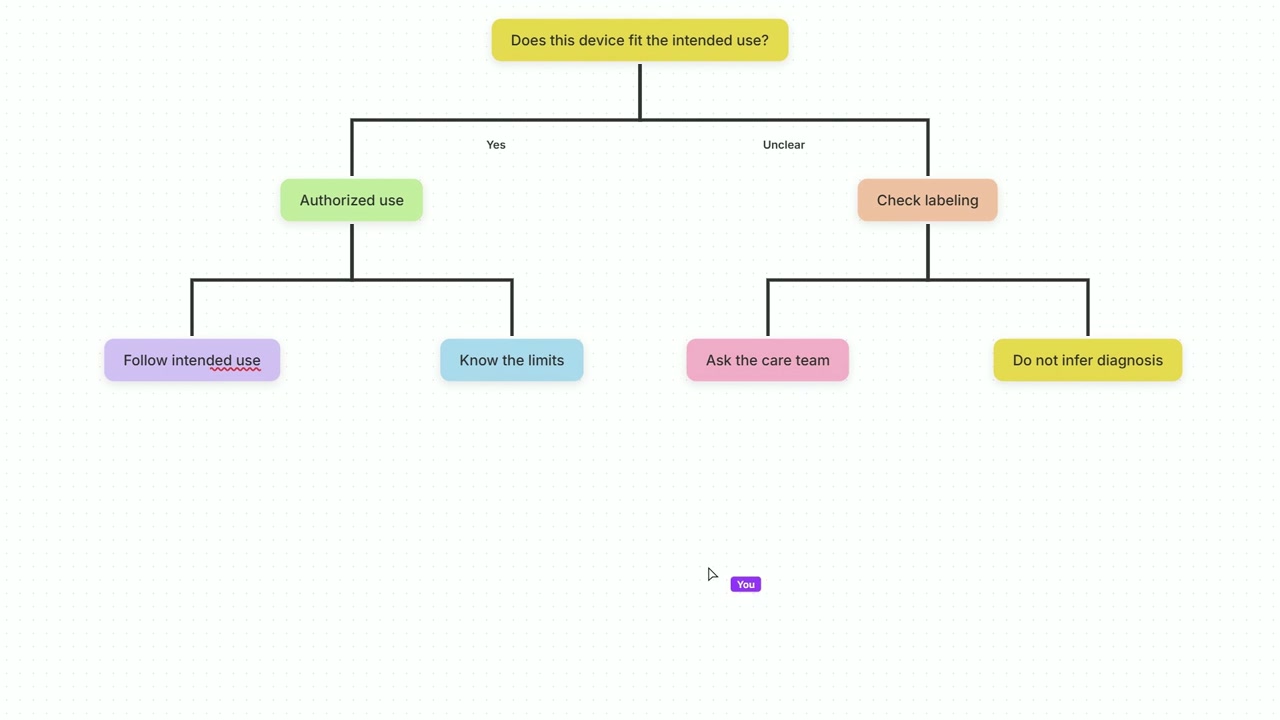
The next clinic may include your home—but a sensor is not the whole clinic. Watches, rings, patches, bands, and specialist home-testing systems can collect useful signals outside a traditional appointment. What matters is not how clinical a device looks. What matters is what the exact product is designed and authorized to do, for whom, in which setting, and with what review.
Start With the Exact Intended Use
The U.S. Food and Drug Administration maintains a list of medical devices that incorporate sensor-based digital health technology. The agency says these devices can capture health information, including in real time outside the clinic. Its list includes devices that are non-invasive or minimally invasive, wearable, suitable for continuous or spot-check monitoring, and usable in settings such as the home.
That does not turn every consumer wearable into a medical device. FDA clearance or authorization applies to a specific product and stated use. Before relying on a reading, check the product name, intended use, age range, setting, prescription status, recording duration, and who is expected to review the result.
Ask Whether the Recording Is Good Enough
A loose band, poor skin contact, motion, inconsistent placement, or an interrupted connection can affect sensor data. More numbers do not automatically mean better information. A well-designed system should show when a recording is incomplete or low quality and explain whether the user should adjust the device, repeat the measurement, or contact a care team.
Context matters too. A home measurement may add information about ordinary sleep, movement, or recovery, while a clinic measurement may offer tighter control. One setting is not automatically superior. The right choice depends on the clinical question and the device's validated conditions of use.
Know What Happens After an Alert
An alert is useful only when there is a clear next step. Does the system recommend repeating the measurement, contacting a clinician, or seeking urgent help? Does a qualified person review the information? Software can organize signals and support decisions, but it should not pretend to replace a comprehensive medical evaluation.
Include Privacy in the Checklist
Home monitoring can create detailed timelines of sleep, movement, heart rhythm, or brain activity. Check who stores the data, how long it is retained, whether it is shared, and how access is controlled. Convenience should not make those questions disappear.
Two Current FDA Examples
The FDA's sensor-based device list includes Onera SleepMap, with a final decision dated March 8, 2026, and the New Wave System, dated March 13, 2026. These examples show why product-specific boundaries matter: one supports analysis of prescribed sleep studies, while the other is a prescription EEG system for defined home or outpatient use. Neither example supports treating all sleep trackers or headsets as equivalent medical tools.
A Practical Five-Question Check
- What exact signal does this product measure?
- What is its stated intended use, population, and setting?
- How does it flag poor-quality or incomplete data?
- Who reviews the result, and what action follows an alert?
- Who stores, shares, and controls access to the data?
Sources and Further Reading
- FDA: Medical Devices that Incorporate Sensor-based Digital Health Technology
- FDA 510(k) record: Onera SleepMap (K253668)
- FDA 510(k) record: New Wave System (K260455)
Medical disclaimer: This article is for educational purposes only and is not medical advice. It does not diagnose, treat, or recommend any medical test, device, medication, or intervention. Speak with a qualified healthcare professional for personal medical concerns.